Page 1 of 3
the gluttony of Energy conservation
Posted: Tue Jul 09, 2013 5:42 pm
by _subgenius
William StanleyJevons explained that improving energy efficiency typically reduced energy costs and thereby increased rather than decreased energy use, an effect now known as the Jevons paradox.
Which means energy efficient cars will see an increase in petroleum use....energy efficient policies will cause a more rapid depletion of resources than not.
I believe this can be seen when extended to the illusion that computers save paper...yet the printer industry thrives (global paper consumption is on the rise = Environmental Paper Network. (2011). The State of the Paper Industry 2011. Retrieved from
http://environmentalpaper.org/state-of- ... y-2011.php.)
Though paper recovery rates in the US have increased in recent years, paper still represents one of the biggest components of solid waste in landfills – 26 million tons (or 16% of landfill solid waste) in 2009. When paper decomposes in a landfill, it releases methane, a greenhouse gas 23 times more potent than carbon dioxide.
So, would not a true nature conservancy attitude be to maintain inefficient fuel consumption?
The evidence surely requires little justification to prove that as we have become more efficient with energy over the past centuries we have dramatically increased its usage and its consumption of resources.
thought?
Re: the gluttony of Energy conservation
Posted: Tue Jul 09, 2013 6:26 pm
by _Res Ipsa
Like the Laffer curve, Jevon's paradox could certainly occur under certain circumstances, but doesn't represent any sort of law of economics. It depends on the shape of the relevant supply and demand curves. For example, the amount of driving I do is determined by lots more factors than the price of gas. Jevon's paradox is fashionable among contrarians, but then contrarianism always is.
ETA: One thing Jevon's paradox does illustrate is that predicting the result of a simple change in an entire economic system is complex and often difficult. If the goal is to reduce consumption of a specific commodity, I think the most effective way to do that is to raise the price of that commodity, or to reduce the price of a substitute for that commodity. So, if you want to reduce the consumption of gasoline, the most effective way to do that is to increase the price of gasoline, as opposed to increasing the efficiency of the vehicle fleet.
Re: the gluttony of Energy conservation
Posted: Wed Jul 10, 2013 1:32 am
by _krose
subgenius wrote:I believe this can be seen when extended to the illusion that computers save paper...yet the printer industry thrives...
Anyone who made that kind of prediction wasn't thinking it through.
That's happening now, however, because of the iPad and e-readers. Now that we can read nearly anything easily and portably, we have much less of a need for printing. Just as an example, I have several printers in my house and office, but I couldn't tell you the last time I printed anything. I don't even print boarding passes anymore; they just scan the bar code on my iPhone. What's more, with electronic billing and banking, I get very few paper bills and statements in the mail, and I never write and mail checks anymore. My pulp footprint is next to nothing, and I'm sure I'm not alone.
This illustrates that it sometimes takes additional technology advances, combined with an effort to conserve.
Re: the gluttony of Energy conservation
Posted: Wed Jul 10, 2013 1:53 am
by _subgenius
krose wrote:subgenius wrote:I believe this can be seen when extended to the illusion that computers save paper...yet the printer industry thrives...
Anyone who made that kind of prediction wasn't thinking it through.
That's happening now, however, because of the iPad and e-readers. Now that we can read nearly anything easily and portably, we have much less of a need for printing. Just as an example, I have several printers in my house and office, but I couldn't tell you the last time I printed anything. I don't even print boarding passes anymore; they just scan the bar code on my iPhone. What's more, with electronic billing and banking, I get very few paper bills and statements in the mail, and I never write and mail checks anymore. My pulp footprint is next to nothing, and I'm sure I'm not alone.
This illustrates that it sometimes takes additional technology advances, combined with an effort to conserve.
krose wrote:subgenius wrote:I believe this can be seen when extended to the illusion that computers save paper...yet the printer industry thrives...
Anyone who made that kind of prediction wasn't thinking it through.
That's happening now, however, because of the iPad and e-readers. Now that we can read nearly anything easily and portably, we have much less of a need for printing. Just as an example, I have several printers in my house and office, but I couldn't tell you the last time I printed anything. I don't even print boarding passes anymore; they just scan the bar code on my iPhone. What's more, with electronic billing and banking, I get very few paper bills and statements in the mail, and I never write and mail checks anymore. My pulp footprint is next to nothing, and I'm sure I'm not alone.
This illustrates that it sometimes takes additional technology advances, combined with an effort to conserve.
But the data posted above contradicts your supposition and supports the paradox noted. Paper consumption is on the increase.
Re: the gluttony of Energy conservation
Posted: Wed Jul 10, 2013 1:57 am
by _subgenius
Brad Hudson wrote:Like the Laffer curve, Jevon's paradox could certainly occur under certain circumstances, but doesn't represent any sort of law of economics. It depends on the shape of the relevant supply and demand curves. For example, the amount of driving I do is determined by lots more factors than the price of gas. Jevon's paradox is fashionable among contrarians, but then contrarianism always is.
ETA: One thing Jevon's paradox does illustrate is that predicting the result of a simple change in an entire economic system is complex and often difficult. If the goal is to reduce consumption of a specific commodity, I think the most effective way to do that is to raise the price of that commodity, or to reduce the price of a substitute for that commodity. So, if you want to reduce the consumption of gasoline, the most effective way to do that is to increase the price of gasoline, as opposed to increasing the efficiency of the vehicle fleet.
What is the consequence of not having efficiency intimately linked to price?
Re: the gluttony of Energy conservation
Posted: Wed Jul 10, 2013 3:56 am
by _Res Ipsa
subgenius wrote:Brad Hudson wrote:Like the Laffer curve, Jevon's paradox could certainly occur under certain circumstances, but doesn't represent any sort of law of economics. It depends on the shape of the relevant supply and demand curves. For example, the amount of driving I do is determined by lots more factors than the price of gas. Jevon's paradox is fashionable among contrarians, but then contrarianism always is.
ETA: One thing Jevon's paradox does illustrate is that predicting the result of a simple change in an entire economic system is complex and often difficult. If the goal is to reduce consumption of a specific commodity, I think the most effective way to do that is to raise the price of that commodity, or to reduce the price of a substitute for that commodity. So, if you want to reduce the consumption of gasoline, the most effective way to do that is to increase the price of gasoline, as opposed to increasing the efficiency of the vehicle fleet.
What is the consequence of not having efficiency intimately linked to price?
Sorry, not sure I understand what you mean by "intimately linked." I suspect, like everything in economics, the answer is "it depends."

Re: the gluttony of Energy conservation
Posted: Wed Jul 10, 2013 2:45 pm
by _krose
subgenius wrote:But the data posted above contradicts your supposition and supports the paradox noted. Paper consumption is on the increase.
You said on the rise "globally." The current paperless trend just started recently, in areas where the technology is in widespread use. It would be interesting to know the printed paper usage per person in the US this year compared to ten years ago. I would be very surprised if that is up.
Re: the gluttony of Energy conservation
Posted: Wed Jul 10, 2013 4:08 pm
by _MeDotOrg
subgenius wrote:William StanleyJevons explained that improving energy efficiency typically reduced energy costs and thereby increased rather than decreased energy use, an effect now known as the Jevons paradox.
Which means energy efficient cars will see an increase in petroleum use....energy efficient policies will cause a more rapid depletion of resources than not.
Let's take 2 examples: automobiles and refrigerators.
In scenario A, automobiles and refrigerators are inefficient.
Refrigerator use remains constant. No one turns off their refrigerator because of energy costs, the refrigerator simply consumes more energy.
The important thing to remember about automobiles is that it demand that influences cost. The demand will certainly be greater if cars average 14 miles per gallon than if they average 30 miles to the gallon. When cars average 14 miles to the gallon, people will drive less.
In scenario B, automobiles and refrigerators are more efficient. Your refrigerator uses less electricity. Your're not going to go out and buy another refrigerator just because your electric bill dropped. For many fixed items energy use will drop.
Now if you own a Prius, are you likely to consume more gasoline than someone with a V-8 4x4 SUV? You may drive
more miles, but you still will consume less gas. If everyone drives a Prius, their will be less demand for gasoline, but that doesn't mean that people consume more and more fuel until the demand is the same as it would be if people were all driving cars that got 14 miles per gallon.
Re: the gluttony of Energy conservation
Posted: Wed Jul 10, 2013 10:44 pm
by _Res Ipsa
Well, sort of. ;-) The refrigerator is a good example of price inelastic demand. If the use of refrigerators varies little with changes in price, then we should expect improvements in refrigerator efficiency to result in reduced use of electricity.
Let's change the refrigerator example in this way: everyone has a refrigerator that can run on electricity or natural gas, and changing from one to the other is as easy as throwing a switch. Let's also say the price of both is identical and that roughly half choose to use gas and half electricity. Now, suppose an improvement in efficiency in the natural gas part of my refrigerator makes it 5% cheaper to run it on gas. That 5% improvement in efficiency would trigger a 100% increase in the use of natural gas for refrigerators. In economic terms, the demand is very price elastic. Thus, Jevon's paradox.
The availability of substitutes plays a major role. For example, if the cost of fuel leads a significant number of commuters to use public transit instead of driving, the drop in cost that would result from an increase in fuel efficiency could cause many of those people to change from public transit to their own cars. That switching could reduce or even swamp the fuel savings from efficiency.
I don't think that the computer/printer/paper example is a good one because there is so much going on at the same time. The efficiency improvement (computer storage) isn't an efficiency improvement in paper or printers. So, strictly speaking, it isn't an example of Jevon's paradox. The availability of pdf's combined with the falling cost of computer storage and the internet has created a substitute for printed paper that, all other things being equal, we would expect to result in reduced paper use. But, over the same period of time, the cost (in time and dollars) of printing has also fallen, which, all other things being equal, we would expect to result in increased paper usage. Because both are happening at the same time, there's really no paradox involved. You just have to account for all the changes.
Re: the gluttony of Energy conservation
Posted: Thu Jul 11, 2013 2:47 pm
by _subgenius
krose wrote:subgenius wrote:But the data posted above contradicts your supposition and supports the paradox noted. Paper consumption is on the increase.
You said on the rise "globally." The current paperless trend just started recently, in areas where the technology is in widespread use. It would be interesting to know the printed paper usage per person in the US this year compared to ten years ago. I would be very surprised if that is up.
the premise remains, regardless of any short-sighted anomalies
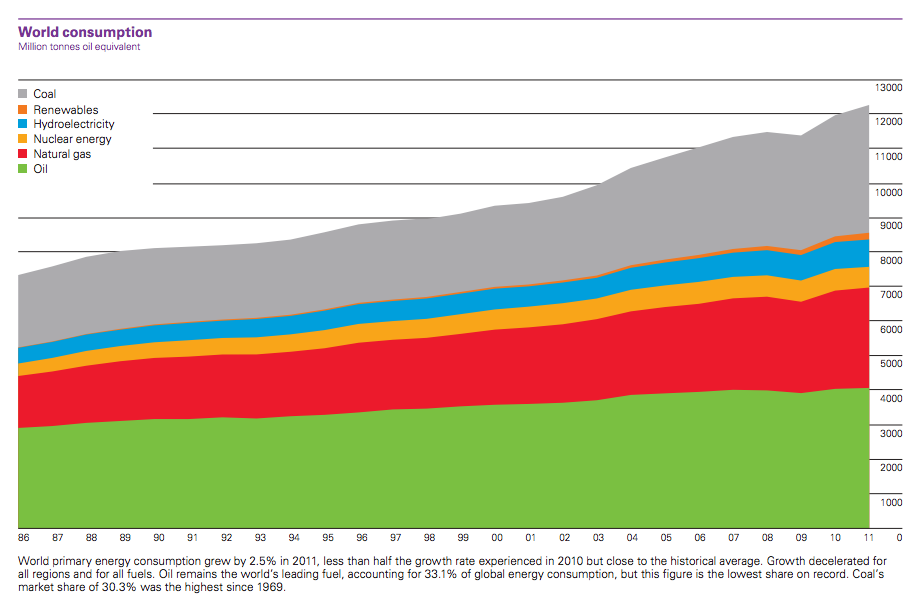
http://www.carbonbrief.org/media/106046 ... .34.23.png"globally" is the most relevant to the topic. I can say that the course of my own career has seen "paperless" technology increases dramatically...yet i have observed no reduction, likely an increase, in the paper being used. My experience being indicative of the larger trend.
Paper has no value in the majority of the world, especially the "technological" world.
Nevertheless, the premise of the OP is valid - even in the microcosm of America
Conservation of energy via efficiency leads to increases in consumption....conservation of energy is best achieved through inefficiency.