Backed into a corner: Dan turns to "fashionable nonsense" to save the church

The catch-all forum for general topics and debates. Minimal moderation. Rated PG to PG-13.
User avatar
Tom
God
Posts: 1174
Joined: Mon Oct 26, 2020 3:41 pm
Location: Sego, Utah
Contact:

Re: Backed into a corner: Dan turns to "fashionable nonsense" to save the church

Post by Tom »

drumdude wrote:
Sat Aug 29, 2026 9:55 pm
Dean Robbers seems to have struck a nerve:
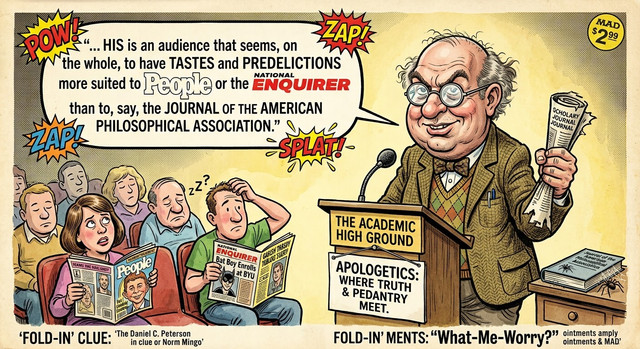
Over at the Peterson Obsession Board, one of the posters seems recently to have assumed the task of interpreting my thinking to his fellow board participants. (He takes his moniker there from a notable Book of Mormon robber and murderer.) It is, I suppose, a noble effort, though I don’t think that his prospects for success in this new enterprise are very high. I mean, his is an audience that seems, on the whole, to have tastes and predilections more suited to People Magazine or the National Enquirer than to, say, the Journal of the American Philosophical Association.
It seems that the Afore over at the Hitchens Obsession Blog has assumed the snobbish task of denigrating the reading habits of DM participants. How would he know what reading tastes and predilections the participants here have? Does he employ remote viewing?

Does he know that last year I read Elizabeth Jackson’s essay, “An Epistemic Version of Pascal's Wager,” published in the September 2024 issue of the Journal of the American Philosophical Society. After she formulates an epistemic version of Pascal’s Wager, Professor Jackson responds to four objections to her reformulated wager. The third objection involves “many gods.” She writes:
One might wonder what the epistemic wager implies about mutually exclusive religions. Suppose I take the epistemic wager and believe in the God of religion 1; I may not get the epistemic goods of religion 2.

My response is twofold. First, it is sensible to simply ask the question of whether one ought to be a theist, and then leave the choice between religions for later. The main purpose of this essay is not to adjudicate between religions, but to draw a connection between general theism and epistemic consequentialism.

Second, if all religions offer roughly the same epistemic goods, then according to the epistemic wager, one should practice the religion that one thinks is most likely to be true. It is not obvious, however, that we should quantify the epistemic value of all religions equally; the epistemic goods to be gained in the afterlife vary widely by religious tradition. For example, as discussed above, on many versions of Christianity, heaven involves the beatific vision—seeing God's essence and gaining a complete understanding of the world. Alternatively, by practicing certain versions of Buddhism, one can eventually reach enlightenment, the state of comprehending reality as it is (see Wright 2016), which also seems quite epistemically valuable. Mormonism teaches that humans can eventually become divine, as they ‘progress toward perfection and ultimately realize their divine destiny as heirs of eternal life’ (Church of Jesus Christ of the Latter-Day [sic] Saints 1995). The epistemic benefits of being divine seem quite significant, to say the least. Thus, various religions at least offer different epistemic goods; there is a further question of how to weigh these goods against each other. If one thinks that a certain religion offers better epistemic goods than another, one can also factor that into the decision table; if one takes the goods of various religions to be infinite, one can utilize one of the decision-theoretic methods for comparing infinities discussed above. A detailed theological comparison of the epistemic goods of various religions is a promising area of further research.
(Mormonism also makes a brief appearance in an essay by Jackson and Andrew Rogers published in a 2019 issue of Philosophia Christi.)

As for me and my house, we prefer reading J-APA to subsisting on a reading diet consisting of articles published by, say, First Things, National Review, Liahona, and Interpreter.
The Afore wrote:(“Don’t believe me?” he writes at the end of one fundamentally misguided exposition. “Ask him!” Which, of course, nobody has. Including him.)
It’s odd that the Afore now is inventing elements of quotations. Where did the Dean write, “Ask him!” The Afore reminds me of movie marketers who invent exclamation points in quoting reviews.

Incidentally, most of the content of the Afore’s blog post today, “Some Thoughts On Islam And Terrorist Violence,” previously appeared in a 2017 Deserted News column, “Why are there so few Muslim terrorists?” Why doesn’t the Afore note that in his blog post? Did the Afore write the 2017 column alone or did Hamblin, who is listed as co-author, write part of it? If Hamblin wrote part of it, shouldn’t the Afore credit him in today’s blog post?

ETA: The Afore has responded to my comment by silently adding this note to his original post: “[Note: The material above is slightly modified from a 2017 Bill Hamblin-Dan Peterson column in the Deseret News of which, as it happens, I was the sole author.]” I wonder when the Afore plans to silently edit his plagiarized potato famine post of eight months ago to credit Mike Dash.

User avatar
Gadianton
God
Posts: 6751
Joined: Sun Oct 25, 2020 11:56 pm
Location: Elsewhere

Re: Backed into a corner: Dan turns to "fashionable nonsense" to save the church

Post by Gadianton »

I did say that, but in another thread. He has ignored my question thus far. And thus far, there is no indication that either the Afore or the many scholars who post at Sic et Non have read or attempted to read Brother Faulconer's fine essay. I may pick it up again after attending to a few matters of the vineyard.

They did, however, swarm over the Afore's complaint about IHAQ asking if something "too hard for the Lord" in regard to bringing rain to Salt Lake. The many scholars of the forum have decided the Lord is using this draught to further his purposes. Some are unsure of what those purposes might be, but by golly, don't attempt to use a tax, the tool of the devil. Others claim it's not heresy to the five books of Moses to have a government intervene with public goods. The state of Israel is looked to as the exemplar of how to effectively use water without offending the Lord's aggressive duty to pure growth. It's really serious thought time for SeN.

Apologies for hijacking IHAQ's thread, I'll copy the relevant portion over there.
"...gain control of land that FARMS owned..." -- Bill Hamblin
"Why did FARMS own land to begin with?" -- Me
User avatar
Equality
Priest
Posts: 309
Joined: Wed Dec 23, 2020 4:41 pm

Re: Backed into a corner: Dan turns to "fashionable nonsense" to save the church

Post by Equality »

POB is the mopologetic equivalent to MAGA's TDS: a deflection tactic designed to stop down substantive discussion.
"Praise be to Allah"--President Donald J. Trump
"I love the inflation"--President Donald J. Trump
User avatar
Doctor CamNC4Me
God
Posts: 11044
Joined: Wed Oct 28, 2020 2:04 am

Re: Backed into a corner: Dan turns to "fashionable nonsense" to save the church

Post by Doctor CamNC4Me »

Image

I’m Madd he didn’t reference my favorite magazine.
Hiring a part-time news entertainment anchor as SecDef, what could go wrong?
Marcus
God
Posts: 8042
Joined: Mon Oct 25, 2021 10:44 pm

Re: Backed into a corner: Dan turns to "fashionable nonsense" to save the church

Post by Marcus »

Marcus wrote:
Sun Aug 30, 2026 12:14 am
...Most of them appear to have a ravenous appetite for gossipy speculation. But for actual ideas and arguments? Maybe offline, perhaps. (Who knows?) There’s little evidence of any deep thinking among most of those on the POB. Just personal contempt, insults, and hostility. And, sometimes, self-congratulation...
Wow. DCP already knows people are well aware of his rampant use of plagiarism to attempt to appear smart. This passage, taken from his failed attempt to insult, seems to be projecting every additional attribute he worries that others see in himself.

The "sometimes, self-congratulation" line is especially hilarious.
Speaking of the afore's "sometimes, self-congratulation" accusation of this board, his latest Meredian article demonstrates his abilities at it perfectly.

He writes about "holy envy":
...By “holy envy,” Stendahl was referring to the recognition of elements in another religious tradition or faith that an outsider appreciates or admires and even wishes were present or found greater scope in his or her own religious faith or tradition, without converting...
The underlying anecdote was from his mission experience. Did he experience holy envy?

Well, no. A Swiss pastor experienced it after he, a teenaged Mormon missionary, taught the religously educated pastor the principles of pastoral care found in home teaching. The pastor was astonished, and according to Dan, expressed that "...he rarely heard in time about people who were sick, troubled, hurting, or sad. He typically didn’t learn about people who were on their deathbeds until after they had died..." Hmm. A reliously educated career pastor really told a 19 year old that?

Moving on, no story of holy envy would be complete without this additional extraneous bit of self-congratulation:
...some time later, a visiting German choir performed in Ringgenberg’s seventeenth-century castle church, where he preached on Sundays, we were the pastor’s special invited guests, seated with him in his family box. I’ve always wondered what his parishioners thought of that!
User avatar
Doctor CamNC4Me
God
Posts: 11044
Joined: Wed Oct 28, 2020 2:04 am

Re: Backed into a corner: Dan turns to "fashionable nonsense" to save the church

Post by Doctor CamNC4Me »

Among the many self-congratulatory howlers he’s dropped is that he learned German so well on his mission he developed a lifelong accent as a result.

Image
Hiring a part-time news entertainment anchor as SecDef, what could go wrong?
User avatar
Physics Guy
God
Posts: 2314
Joined: Tue Oct 27, 2020 7:40 am
Location: on the battlefield of life

Re: Backed into a corner: Dan turns to "fashionable nonsense" to save the church

Post by Physics Guy »

My favourite take on deconstruction is this 1991 essay by software engineer Chip Morningstar (which I believe is just the guy's real name—he has a Wikipedia page). Morningstar's essay is not just a mocking takedown like Sokal's. As he summarises near the end,
Chip Morningstar wrote:[M]y quest was to learn if there was any content to this stuff and if it was or was not bogus. Well, my assessment is that there is indeed some content, much of it interesting. The question of bogosity, however, is a little more difficult. ... The quality of the actual analysis of various literary works varies tremendously and must be judged on a case-by-case basis, but I find most of it highly questionable. Buried in the muck, however, are a set of important and interesting ideas: that in reading a work it is illuminating to consider the contrast between what is said and what is not said, between what is explicit and what is assumed, and that popular notions of truth and value depend to a disturbingly high degree on the reader's credulity and willingness to accept the text's own claims as to its validity.
I have also attempted to read Derrida (in English), but found him too tediously longwinded. Derrida's communication tactic seemed to be siege warfare rather than assault, wearing the reader down at length rather than getting quickly to a point, and risking the failure of having the point seem trivial. For what it's worth, I sort of agree with Morningstar, that Derrida was getting at some worthwhile things. I just strongly suspect, though, that if it weren't expressed in this fancy-dancing way then it would mostly seem like common sense, would take a lot fewer pages to say, and wouldn't seem profound enough to justify all the attention.

I started trying to read Faulconer's essay and didn't find it too much better. I give him credit for introducing some discussion about a pen, as a concrete example of something, but he dragged out the discussion to the point where it, too, became tedious. Maybe I'm just a philosophical wimp, or an ignorant Philistine. Or maybe these guys are admiring the Emperor's new clothes, and don't understand that most of us just think he's naked, so if you want to persuade us, you've really got to hit us with your best shot hard and fast. You haven't got us surrounded, and we're not going to sit through the siege.
Join the Pirate Philosophers: We think, therefore we Arrr!
User avatar
Gadianton
God
Posts: 6751
Joined: Sun Oct 25, 2020 11:56 pm
Location: Elsewhere

Re: Backed into a corner: Dan turns to "fashionable nonsense" to save the church

Post by Gadianton »

Well, friends, after a reasonable night's sleep and finishing up some distracting projects that really took it out of me yesterday, I was able to re-read some parts and then finish Brother Faulconer's essay. I encourage Dan to grab himself a cup of coffee at the nearest convenience store, skip church today, and read. I am brewing a cup at this very moment and plan to sip it as I write. Join me with a dark brew, Dan. No cream or sugar for us. Just strong, black coffee, symbolic of Brother Faulconer's no-frills exposition.

I think the essay was good assuming the audience has a basic understanding of the subject already, but it's pretty rough as a primer. Granted, Brother Faulconer's mastery of the subject is far, far beyond my own. Anyway, the parts of the essay I find most frustrating is all the gushing about "the other" and "holiness" -- the reverence before the text and all of that, which I do think is nonsense. Then again, this is how postmodernists talk about what they do, in inflated spiritual terms, and so Faulconer isn't wrong.

Anyway, let's start here:
Brother Faulconer wrote: A deconstruction shows us that something has been overlooked or omitted that is necessary for the text’s claim to be true, full-stop. Deconstruction shows that the text implicitly demands the to-come
Since the context is Mormonism, what do we say about the Book of Mormon, which claims to be the most true of any book ever written? Faulconer briefly hits upon the mechanics of deconstruction as he explains Derrida's commentary on Plato's speech/writing "binary", but much what what he says aside from that might give a person the wrong idea. The footnote example in particular can be confusing. A footnote, per Derrida, proves the text is insufficient, or else why does it need a footnote? If this is all Derrida were saying, Mormons can quickly make room for it because we can think of the truth of the Book of Mormon as an unfolding -- if it said everything there is to say, how could you apply it to your life, find new parallels, have GA's writing commentaries and make $$$ for their hedge fund and ride the backs of the poor?

A Mormon may hesitate but ultimately swallow Derrida's real point that texts are not only incomplete but necessarily incomplete. That means not even God can dictate a text that is 100% true, even in the Adamic language. That's a tough sell, but with the right spin, I think a perceptive Mormon can make it work. But even this vastly understates the problem, it's not just the incompleteness, it's the way that incompleteness happens that should make a Mormon worried.

I think yin and yang is helpful. The white squiggly thing has a little black dot and the black squiggly thing has a little white dot, signifying that there are no true opposites. In other words, "good" and "evil", "right" and "wrong" are not true opposites. "God" and "Satan" aren't true opposites. This seems to defy everything Mormonism stands for. And there is no hope of refining the terms such that one day the terminology gets better and we discover true-good and true-evil, such that we have a pure reference to God and also one for the devil. In fact, the opposition is what makes meaning possible to begin with.

Another way to make the point is with the saying: "two sides of the same coin." Paradise Lost, in my opinion, is a great example of deconstruction as it shows, unintentionally, that God and Satan are "two sides of the same coin". Satan's real issue isn't that he's bad, it's his wanting to be like God. So what does that make God then? Deconstructive readings are subversive, looking for the unintended consequences of an author. To a point, it's intuitive, too much order and you've got a police state, too much chaos and creativity falls way to meaninglessness. Yin-yang needs a little of both.

It may be no surprise that the greater the lack of self-awareness, the more prone a text is to deconstruction. Narratives portraying plastic-faced religiosity are among the texts most easily deconstructed. (Should Mormons be very afraid here?) The squeaky clean good-guy is as likely to be an intolerant prick as the bad guy is likely to be a damaged soul with redemptive good, like Darth Vader. Deconstruction seems to say that the more effort you put into making the good guy good in your narrative and the bad guy bad, the more likely you'll end up with an easy subversion.

Mormons are right that you can't know the good without the bad, where they are wrong is not appreciating the consequences of that. Per deconstruction, you can't write a text that articulates good as a positive thing in itself, you can only make good "good" by contrasting it with bad, and ultimately, by marginalizing bad. In other words, you can't elevate "good" by its own praiseworthy qualities, but only by beating down and persecuting "bad". It's hard to describe at a theoretical level, but I think it's intuitive when you see it in action. When you see Milton's Satan become more believable as he takes on God's own authoritarian attributes. As that interplay unfolds, Good and evil become each their other deferred.

The Book of Mormon is ripe for deconstruction given it's built on vulgar streotypes, and perhaps to get ahead of the problem, Grant Hardy wrote his "Reader's guide" book. Hardy never mentions Derrida, but it's obvious what he's doing. He doesn't say "deconstruction" but he does say "close reading" which is exactly what Derrida says. Anytime a literary critic says they are going to "closely read" "a text" it's a dog whistle for deconstruction. I think his attempt is brilliant and I wish I would have thought of it. If Darth Vader is the example of a damaged soul, then the right example of a self-righteous prick would be Captain Moroni. And Hardy goes to town here. You'd think it would be a critic doing this, but it's a faithful committed member who first deconstructs Moroni, showing that he's a hot headed, intolerant, genocidal maniac. This really hits home as you back up to appreciate that Captain Moroni is the paradigm of clean-living righteous heroism for Mormon youth. And this is what's so fascinating: what makes Moroni so wonderful for insular members is the very fact that he's a self-righteous prick. It really is two sides of the same coin. Yes, Dan, we should be very afraid of religion.

But Hardy is ahead of the game, it wasn't his deconstruction of Moroni as a total prick that is brilliant, that much was obvious, it's his long game of making Joseph Smith's complete lack of self-awareness and ease of subversion a feature of his text. Thanks to all the possible subversions, the text is now complex and earthy. The Book of Mormon goes form being a kid's juice box to the black coffee I'm drinking this morning. This is next-level apologetics. And he did this at an opportune time, I believe his book was published when Breaking Bad was going strong, which many regard as the greatest TV series ever in that there is no true good or true evil, it's yin and yang at its dramatic best. And recall the reimagined (somewhat deconstructed) Battle Star Galactica: much better than the original which tried to show people=good and Silons=bad. It's a much better plot when we consider the plight of the marginalized Silons. But where could this possibly leave Chapel Mormonism? Probably stranded on a shining planet called Earth where they have none of their previous advantages and must learn to survive like any other animal. I've strayed because Faulconer avoids talking about real connections between deconstruction and Mormonism in all but the most theoretical terms and I think we need some examples.
Last edited by Gadianton on Sun Aug 30, 2026 9:00 pm, edited 1 time in total.
"...gain control of land that FARMS owned..." -- Bill Hamblin
"Why did FARMS own land to begin with?" -- Me
User avatar
Everybody Wang Chung
God
Posts: 3828
Joined: Wed Oct 28, 2020 1:52 am

Re: Backed into a corner: Dan turns to "fashionable nonsense" to save the church

Post by Everybody Wang Chung »

Marcus wrote:
Sun Aug 30, 2026 7:11 pm
Marcus wrote:
Sun Aug 30, 2026 12:14 am
Wow. DCP already knows people are well aware of his rampant use of plagiarism to attempt to appear smart. This passage, taken from his failed attempt to insult, seems to be projecting every additional attribute he worries that others see in himself.

The "sometimes, self-congratulation" line is especially hilarious.
Speaking of the afore's "sometimes, self-congratulation" accusation of this board, his latest Meredian article demonstrates his abilities at it perfectly.

He writes about "holy envy":
...By “holy envy,” Stendahl was referring to the recognition of elements in another religious tradition or faith that an outsider appreciates or admires and even wishes were present or found greater scope in his or her own religious faith or tradition, without converting...
The underlying anecdote was from his mission experience. Did he experience holy envy?

Well, no. A Swiss pastor experienced it after he, a teenaged Mormon missionary, taught the religously educated pastor the principles of pastoral care found in home teaching. The pastor was astonished, and according to Dan, expressed that "...he rarely heard in time about people who were sick, troubled, hurting, or sad. He typically didn’t learn about people who were on their deathbeds until after they had died..." Hmm. A reliously educated career pastor really told a 19 year old that?

Moving on, no story of holy envy would be complete without this additional extraneous bit of self-congratulation:
...some time later, a visiting German choir performed in Ringgenberg’s seventeenth-century castle church, where he preached on Sundays, we were the pastor’s special invited guests, seated with him in his family box. I’ve always wondered what his parishioners thought of that!
The extreme narcissism, the runaway ego, the beef pizza, the groping in dark BYU basements, that permanent fake accent, and the absolute conviction that he’s the greatest missionary to ever walk the earth… Folks, you couldn't script this level of unhinged absurdity if you tried.

An uncensored look at what happens inside Dan’s man cave:
Image
"I'm on paid sabbatical from BYU in exchange for my promise to use this time to finish two books."

Daniel C. Peterson, 2014
User avatar
Limnor
God
Posts: 1751
Joined: Mon Sep 04, 2023 12:55 am

Re: Backed into a corner: Dan turns to "fashionable nonsense" to save the church

Post by Limnor »

Gadianton wrote:
Sun Aug 30, 2026 8:08 pm
Another way to make the point is with the saying: "two sides of the same coin." Paradise Lost, in my opinion, is a great example of deconstruction as it shows, unintentionally, that God and Satan are "two sides of the same coin".


The Book of Mormon is ripe for deconstruction given it's built on vulgar streotypes, and perhaps to get ahead of the problem, Grant Hardy wrote his "Reader's guide" book. Hardy never mentions Derrida, but it's obvious what he's doing. He doesn't say "deconstruction" but he does say "close reading" which is exactly what Derrida says. Anytime a literary critic says they are going to "closely read" "a text" it's a dog whistle for deconstruction. I think his attempt is brilliant and I wish I would have thought of it. If Darth Vader is the example of a damaged soul, then the right example of a self-righteous prick would be Captain Moroni. And Hardy goes to town here. You'd think it would be a critic doing this, but it's a faithful committed member who first deconstructs Moroni, showing that he's a hot headed, intolerant, genocidal maniac. This really hits home as you back up to appreciate that Captain Moroni is the paradigm of clean-living righteous heroism for Mormon youth. And this is what's so fascinating: what makes Moroni so wonderful for insular members is the very fact that he's a self-righteous prick. It really is two sides of the same coin. Yes, Dan, we should be very afraid of religion.
This is really fascinating to me as I’ve explored the idea that the antichrists in the book represent the “inner self” or belief that needs to be destroyed by members of the group in order to continue on.

Moroni and Amalickiah seem to hear out this dual phenomonolgy as well, as it seems like the more Moroni fights Amalickiah’s world of violence and rebellion, the more the Moroni starts to look like that which he is fighting.
Post Reply