stemelbow wrote:... All I have done is suggested people are misunderstanding Peterson's point. I've stuck to that. ...
You have indeed made that perfectly clear.
Next, how about explaining exactly what you think Peterson's point is, in your own words?
Where did stembelism go?
“We look to not only the spiritual but also the temporal, and we believe that a person who is impoverished temporally cannot blossom spiritually.” Keith McMullin - Counsellor in Presiding Bishopric
"One, two, three...let's go shopping!" Thomas S Monson - Prophet, Seer, Revelator
stemelbow wrote: he did not say there was no counter-explanation. He said that there are no counter-explanations that fit with the known evidence as well as Joseph's own explanation. .
That's funny because I don't think that Joseph's explanation fits the known evidence well at all--especially if (a la Gadianton's remarks) one draws a fairly large circle of things to consider (the whole scientific web of knowledge). But I think it isn't a good fit even locally so to speak. Even religious types usually don't believe it!
when believers want to give their claims more weight, they dress these claims up in scientific terms. When believers want to belittle atheism or secular humanism, they call it a "religion". -Beastie
yesterday's Mormon doctrine is today's Mormon folklore.-Buffalo
DCP gives his favorite and primary example of what he thinks Joseph Smith's version of events better explains than a secular account - the witnesses.
DCP is very fond of this argument and has used it many times over the years. He thinks explaining the witnesses without resorting to them actually having seen what the testimonials assert requires epicycle after epicycle of explanation while the divine origin of the Book of Mormon is simple and elegant. If you try to point out how ludicrously implausible his preferred magical explanation is, he will accuse you of dismissing angels out of hand, pack his bags, and go home. So his argument really is smuggling in a completely unwarranted prior probability in the existence of the magic events that underlies his story in order to argue its probability.
If you try to point out the countless other examples of dubious witness testimony where it is difficult to know what is motivating the witnesses - say with alien abductions - he'll again complain about being unfairly dismissed out of hand. But none of that is needed in this case. He's also employing a bad eliminative argument identical in form to the lord, liar, or lunatic argument popular among hardcore evangelical fundamentalists. He argues that the witness testimony was legit. He offers that as the alternative to thinking the witnesses were lying or lunatics. He fails to see good evidence of either, so defaults to legit. But lack of a positive case for his alternative options doesn't help here. Forgetting the fact that "lying or lunacy" oversimplifies the issue to the point of false dichotomy, maybe the evidence isn't good enough to support any position. You can't construct an eliminative argument in this case. And when burdened with providing positive evidence, he doesn't seem up to the task. His secular argument is no such thing. It's an argument that attacks the adequacy of secular explanation then defaults to divinity, just like any other God of the gaps argument.
This all should be intuitively obvious to anyone who isn't the type to be suckered by those ignorant lord, liar, or lunatic arguments just the same. And I think that's why DCP prefers to publish in protected venues where pointing it out can be quickly censored so his real audience doesn't get the wrong idea.
EAllusion wrote:His secular argument is no such thing. It's an argument that attacks the adequacy of secular explanation then defaults to divinity, just like any other God of the gaps argument.
Excellent point.
"Petition wasn’t meant to start a witch hunt as I’ve said 6000 times." ~ Hanna Seariac, LDS apologist
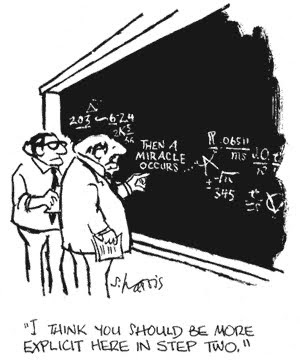
"Well, God could do anything, so that could've happened" isn't a strength, it is a profound weakness. It's the ultimate ad hoc. In order for his theory that a deity telepathically communicated the contents of actual golden plates of an actual ancient civilization to be superior to his strawmanish alternatives that would require auxiliary evidence of the who's and how's that could provide explanatory hypotheses that can be empirically tested in the same way he requires of his alternatives. "A heretofore unsupported god-being did something, somewhere, somehow, for ultimately mysterious motives” is not a workable model of translation or account of why there are testimonies of seeing golden plates. This is just God of the Gaps - which is the antithesis of a secular argument.
But, pretty much the exact same flaws infect the intelligent design movement he is so fond of, and he regards that as persuasive secular argument too. This isn't surprising. What's surprising is that some people take him as seriously as they do.
Tarski wrote:That's funny because I don't think that Joseph's explanation fits the known evidence well at all--especially if (a la Gadianton's remarks) one draws a fairly large circle of things to consider (the whole scientific web of knowledge). But I think it isn't a good fit even locally so to speak. Even religious types usually don't believe it!
I'd say you have a sensible response. I don't really see how Peterson's point holds much water, myself. The secular perspective presumes off the top that God did not appear to Joseph Smith. From that point on, there is very little else to consider in a secular sense. His point seems backwards to me. Its a shame so many in this thread seemed to miss the boat from the outset, if you ask me.
Love ya tons, Stem
I ain't nuttin'. don't get all worked up on account of me.
~Those who benefit from the status quo always attribute inequities to the choices of the underdog.~Ann Crittenden ~The Goddess is not separate from the world-She is the world and all things in it.~
As I see it, the single most persuasive secular argument for the authenticity of the founding events of the Restoration isn't actually a single argument or line of evidence at all. It's the fact that no counterexplanation yet proposed for those events accounts for all the relevant data nearly as well as Joseph Smith's own story does.
The unspoken assumption here is that Mormonism is somehow unique. The assumption is that Joseph Smith was the only one who ever authored new scripture, healed the sick, cast out devils, foretold the future, etc. L. Ron Hubbard did all these things, on a grander scale. Scientology is Mormonism writ large.
closer to Joseph Smith's home, Shakers founder Ann Lee had revelations, could speak in tongues, healed the sick, miraculously escaped death. many people witnessed these events. does DCP have a secular explanation for that?
there are so many similar examples, from so many different times and places, and which include all the same particulars as Joseph Smith's ministry, that i find it truly impressive that educated people like DCP can maintain the doublethink.
Kishkumen wrote: And I say that a 19th century novel that cribs the King James Bible with a vengeance is not something I would struggle to explain. Its explanation is very obvious. I don't need to scratch my head and wonder how it is that Joseph copied Isaiah while removing the italicized words and substituting his best guesses. It sort of screams out its own explanation. Just because a bunch of guys who bought into Joseph's publicized version of the production of the Book of Mormon wasted hundreds of good hours looking for Hebraisms in a work that is based on the Bible doesn't mean the rest of us have to give it a second's thought.
The fact that the same group of people who chased the buried treasure of Captain Kidd and Indian ghosts night after night believed the latest tall tale of their village seer is not all that impressive. Just what is the uneducated opinion of a "respectable" local crackpot in Palmyra worth by today's reckoning? I would give him the same credit as a UFOlogist warehouse owner in Topeka with a Bachelor's degree in English from the State U. In other words, not a hell of a lot.